
The Talaria Sting R MX4 outperforms the Sting MX3 with an 8kW IPM motor, 2,700Wh battery, 220mm brake rotors, and roughly 75 miles of range. The MX3 uses a 6kW PMSM motor, 2,280Wh battery, 203mm rotors, and delivers around 44 miles per charge. The MX4 costs about $1,000 more and targets performance riders, while the MX3 remains the budget-friendly pick for casual trail riders.
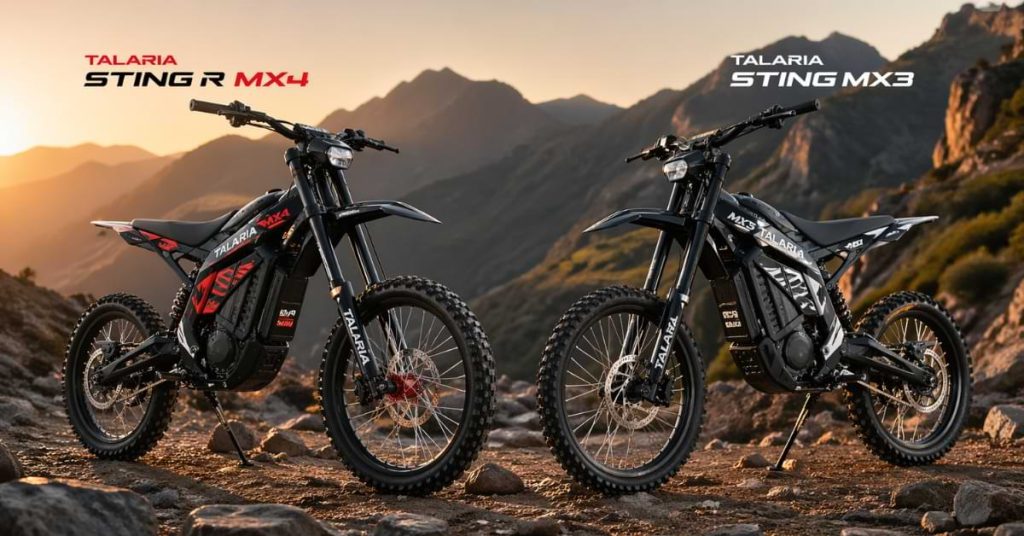
Talaria MX3 vs MX4 at a Glance
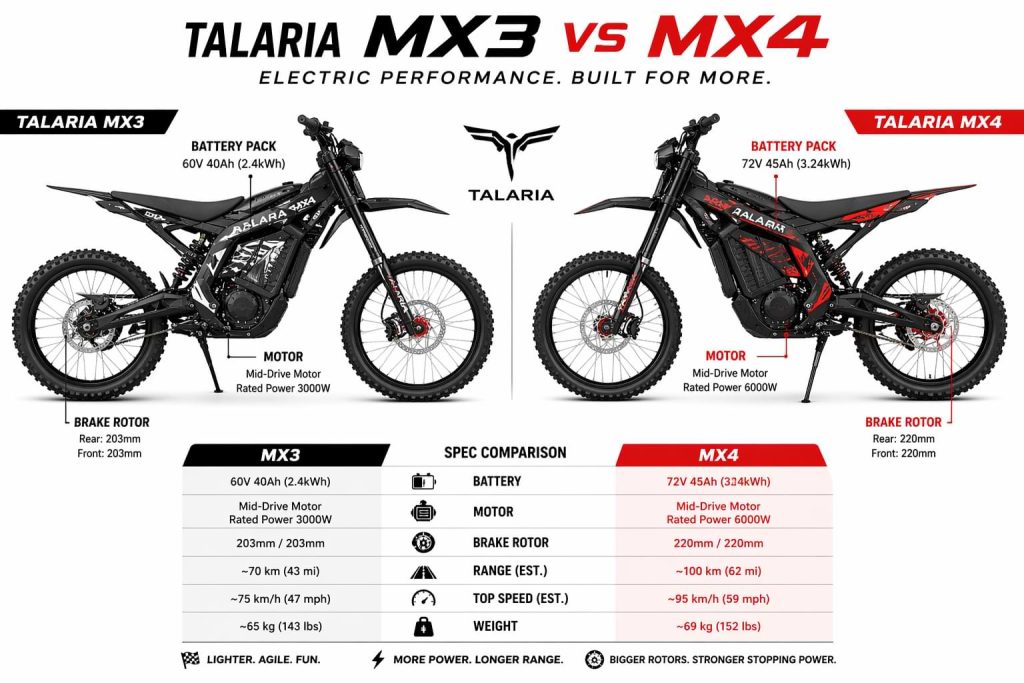
Core differences in numbers
- Peak power: MX4 8,000W vs MX3 6,000W (+33%)
- Battery: MX4 2,700Wh vs MX3 2,280Wh (+18%)
- Motor: MX4 IPM vs MX3 PMSM
- Range: MX4 ~75 miles vs MX3 ~44 miles
- Top speed (unrestricted): MX4 ~50 mph vs MX3 ~47 mph
- Price gap: MX4 is about $1,000 more than MX3
Full Specs Comparison Table
| Measurement | Talaria Sting MX3 | Talaria Sting R MX4 |
| Peak Power (watts) | 6,000W | 8,000W |
| Nominal Power (watts) | 4,000W | 4,000W |
| Motor Type | PMSM (Permanent Magnet Synchronous) | IPM (Interior Permanent Magnet) |
| Battery (Ah / Wh) | 60V 38.4Ah / 2,280Wh | 60V 45Ah / 2,700Wh |
| Battery Cells | LG 21700 lithium-ion | LG 21700 lithium-ion |
| Peak Torque (motor) | ~45 N·m | 45 N·m |
| Top Speed (unrestricted) | ~47 mph (75 km/h) | ~50 mph (85 km/h) |
| Range (at moderate pace) | 44–50 miles (70–80 km) | ~75 miles (120 km) |
| Charging Time (0–100%) | 2.5–3.5 hours | 3 hours |
| Brake Rotors (front/rear) | 203mm × 2.0mm | 220mm × 2.3mm |
| Transmission | Gearbox + chain | Gearbox + chain |
| Seat Height | 840mm (33.1 in) | 840mm (33.1 in) |
| Weight (with battery) | ~58 kg (128 lb) | 66 kg (145 lb) |
| Regen Braking Levels | 4 levels adjustable | 4 levels adjustable |
| Price Range (USD) | $3,390–$3,990 | $3,999–$4,399 |
| Price Range (CAD) | ~$4,999 | ~$5,999 |
| Warranty | 1-year limited | 1-year limited |
Talaria Sting MX3: Specs, Rider Fit and Key Features
The MX3 is the entry point into Talaria’s Sting lineup. It shares the same frame and chassis geometry as the MX4 but runs a smaller battery and different motor architecture to hit its lower price point.
Who is the MX3 best for?
- First-time electric dirt bike buyers want proven reliability without paying a premium
- Trail riders who stay under 45 mph on 20–30 mile loops
- Modders planning to upgrade the battery and controller later
- Commuters needing quiet, low-maintenance off-road transport
Key MX3 features
- 6,000W peak PMSM mid-drive motor with instant torque
- 60V 38.4Ah swappable battery using LG 21700 cells
- Intelligent gearbox transmission – no belts to replace
- OLED display with ECO/Sport modes and adjustable regen
- 4-piston hydraulic brakes with 203mm rotors
- Forged 6061 aluminum alloy frame
Talaria Sting R MX4: Specs, Rider Fit, and Key Features
Launched in 2023, the Sting R MX4 is Talaria’s answer to riders wanting more top speed, longer range, and better stopping power than the MX3 offered. It keeps the familiar Sting chassis but upgrades the motor, battery, brakes, and throttle electronics.
Who is the MX4 best for?
- Experienced riders moving from gas-powered 125cc–250cc bikes
- Riders doing 40+ mile sessions who can’t stop to swap batteries
- Anyone wanting cleaner power delivery and stronger brakes stock
- Buyers who won’t heavily modify and want it strong out of the box
Key MX4 upgrades over the MX3
- IPM motor with magnetic encoder – higher efficiency and upgrade headroom
- 45Ah battery with 2,700Wh – 18% more range capacity
- 220mm × 2.3mm rotors delivering ~20% more stopping power
- +30% peak power, reaching 8kW
- Smoother throttle response from an encoder-based system
- Reinforced frame, swingarm, and improved battery connector
Performance Differences That Matter on the Trail
The MX4’s IPM motor is the biggest under-the-hood change. Where the MX3’s PMSM motor has magnets bolted to the rotor surface, the IPM embeds magnets inside the rotor. That means fewer failure points and more power-handling capacity if you upgrade the controller later.
Range is the other headline gap. With 420Wh more battery capacity, the MX4 can push an extra 20–30 miles between charges in real conditions a practical difference for long trail days or commuting.
Stopping power scales with speed, and the MX4’s bigger rotors aren’t optional they’re necessary. The 203mm rotors on the MX3 are adequate for its power, but anyone running the MX4’s full 8kW without upgraded brakes would quickly feel the limit. For real-world acceleration times, our detailed top speed comparison has full data.
How Riders Actually Phrase This Question
“Is the MX4 worth the extra $1,000 over the MX3?”
If you ride aggressively, do long sessions, or plan to keep the bike stock, yes. If you’ll cap rides under 45 mph on moderate trails, the MX3 is the better value.
“Can I upgrade an MX3 to match the MX4?”
Partially. You can swap to a 45Ah battery and upgrade the controller, but the PMSM motor caps your ceiling. The IPM motor in the MX4 is the structural upgrade you can’t easily replicate.
“Are MX3 and MX4 parts cross-compatible?”
Most chassis parts, footpegs, suspension components, and plastics are shared. The headlight and kill switch use different pin connectors, and the motors and batteries are not interchangeable.
Pricing Across Markets
Both bikes are sold globally, but pricing varies based on shipping, taxes, and dealer distribution. For a full regional breakdown, see our Talaria pit bike cost guide.
- United States: MX3 from $3,390–$3,990 | MX4 from $3,999–$4,399
- Canada: MX3 around $4,999 CAD | MX4 around $5,999 CAD
- UK & Europe: Availability varies by dealer; expect a 10–15% premium over US pricing after VAT and import
- Australia: Limited authorized dealers; bikes often priced AUD $6,500+ for MX3, AUD $8,000+ for MX4
Common Mistakes When Choosing Between MX3 and MX4
- Buying the MX3 planning to “just upgrade it later,” by the time you swap battery, controller, and motor, you’ve spent more than the MX4 retail price
- Assuming both bikes are equally street-capable, both are sold for off-road use only and need a separate street-legal conversion kit
- Ignoring the brake difference when modifying the MX3, adding power without upgrading the 203mm rotors, is a safety issue
- Thinking the MX4 is just a “faster MX3,” the IPM motor and encoder throttle make it a meaningfully different riding experience
- Overlooking shipping costs and dealer setup fees these can add $250–$500, depending on region
Frequently Asked Questions
How fast does the Talaria MX4 go?
The MX4 ships factory-limited to 20 mph. Unrestricted, it reaches roughly 50 mph (85 km/h), a 13% top speed increase over the MX3.
How fast does the Talaria MX3 go?
The Talaria Sting MX3 tops out around 47 mph (75 km/h) unrestricted. Factory settings are typically limited for compliance.
Is the MX4 the same as the Sting R?
Yes. “Sting R MX4” and “MX4” refer to the same bike. Some markets also list it as the TL4000.
Is a Talaria the same as a Sur-Ron?
No. Though they share a similar form factor, the two brands have different motors, batteries, and drivetrains. See our breakdown of Talaria vs Sur-Ron differences for a full comparison, and our Sur-Ron alternatives guide for other options in this category.
What about the Talaria XXX?
The Talaria XXX (also called X3) is a smaller, lighter commuter-focused model not a direct competitor to the Sting series. Check our Talaria XXX performance guide for specs.
Final Verdict: Which Talaria Should You Buy?
Pick the MX3 if your budget is tight, you ride moderate trails, or you want a proven platform to modify gradually over time. It’s the same frame, same swappable-battery convenience, and has thousands of satisfied owners.
Pick the MX4 if you want the better motor, longer range, and stronger brakes from day one without having to upgrade anything. For riders who’ll use the full performance, the extra $1,000 pays for itself in hardware that would cost more to add aftermarket.